Spotted Lanternflies on the Dog Walk — and a Call from The Guardian
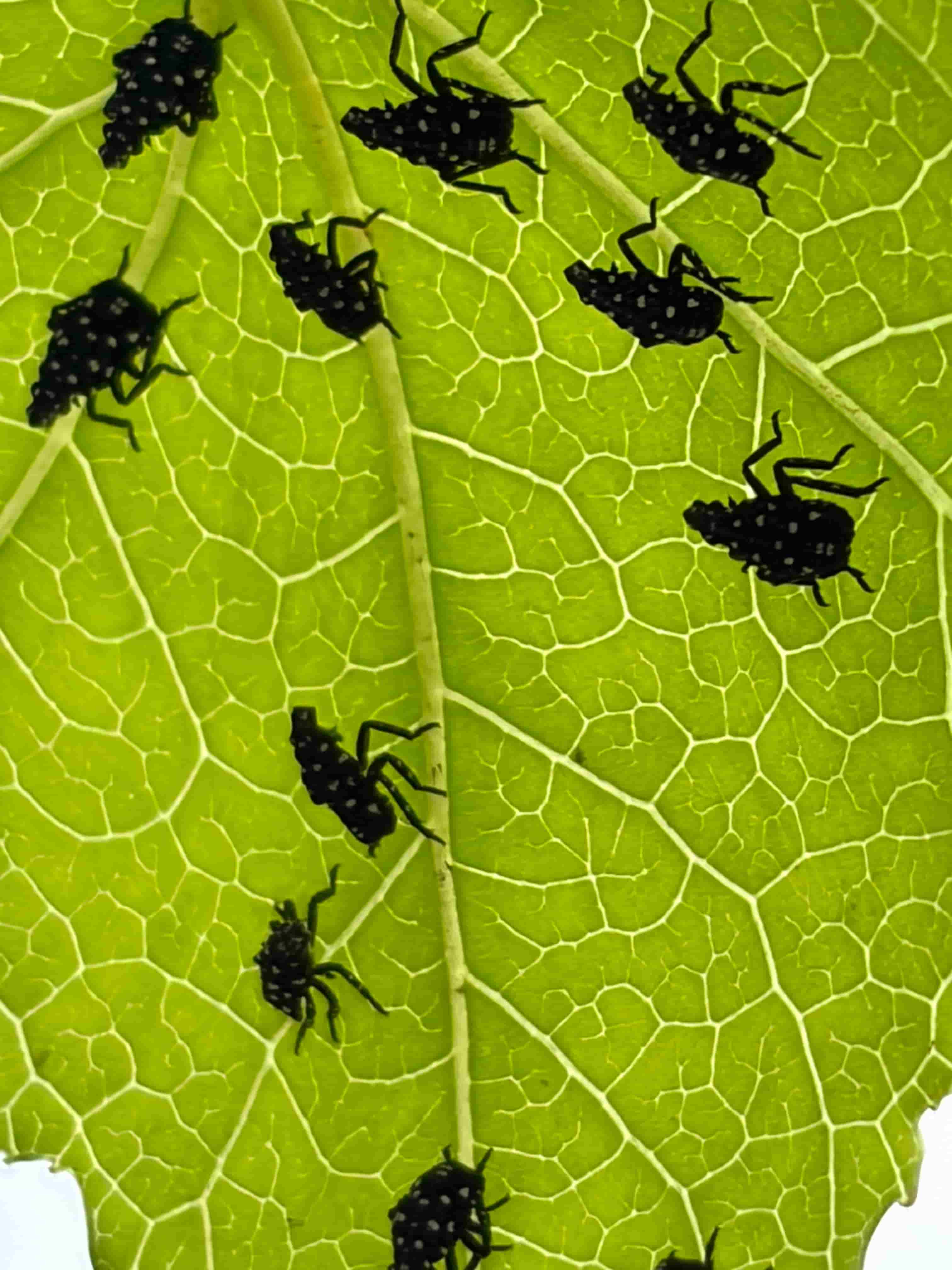
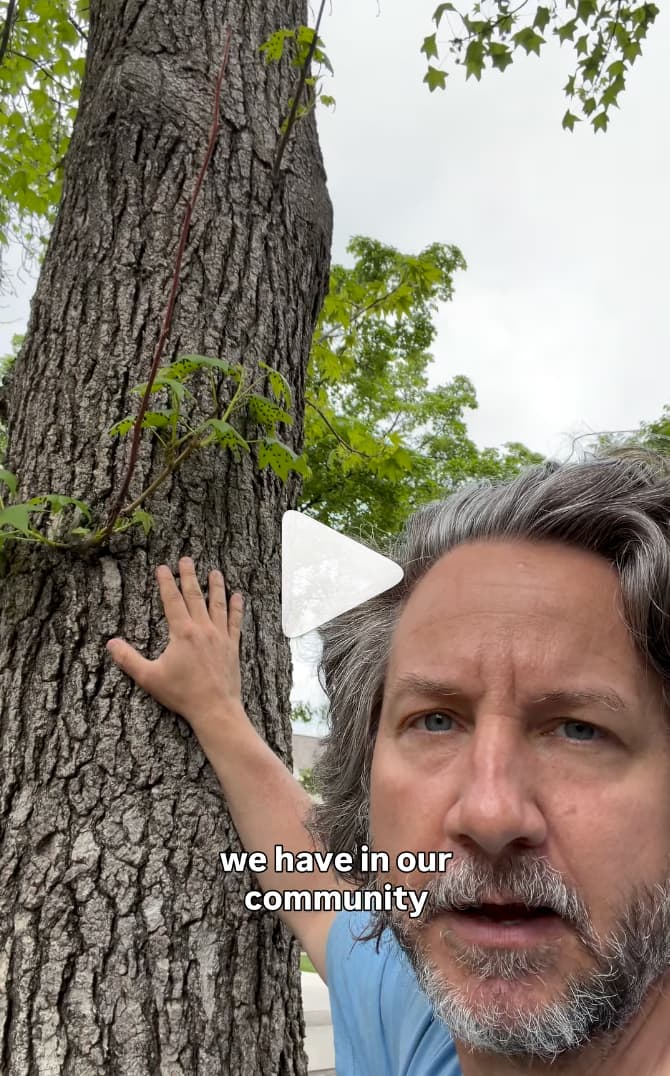
A reporter from The Guardian called me last week. They had seen an educational video I'd posted on a dog walk in Upper Arlington — me pointing at a sweetgum (Liquidambar styraciflua) leaf full of spotted lanternfly nymphs and telling homeowners to go look at their trees. The piece they were writing was about US vineyards. I'm an arborist in Ohio. We talked for a half hour. Two of my quotes made it into the piece — the storm-season mechanism behind urban tree failure, and the homeowner action. The Upper Arlington / Tree City USA framing came out of the same conversation. Here's the longer version behind each.
Tree City USA on the dog walk.
Upper Arlington is a Tree City USA. That's an Arbor Day Foundation designation that takes a tree board, a public tree ordinance, two dollars per resident in community forestry spending, and an annual Arbor Day observance to earn. Most people who live here couldn't tell you any of that. They know there are big trees on every street and that the city replaces them when they come down. The dense canopy is the asset — and the vulnerability.
The mechanism: feeding, freeze, windstorm.
The first of my two printed quotes was the storm-season mechanism: "When the bugs infest a tree during the summer and that is followed by an especially cold winter, that can cause branches to break or roots to decay." A summer of feeding strips the tree's reserves. A hard freeze tests what's left. A March windstorm answers the question.
That's the field version. Here's the science underneath it. Spotted lanternfly isn't a tree-killer the way emerald ash borer is. Penn State Extension puts it plainly: "SLF is a plant stressor that, in combination with other stressors (e.g., other insects, diseases, weather), can cause significant damage to its host. SLF alone may not kill the tree." That's the compounding-stress mechanism. Heavy feeding reduces a tree's photosynthesis and depletes the carbohydrate reserves it stores for the next growing season; PSU research has measured nutrient loss and reduced diameter growth in the heaviest feeding years.
Penn State's Kelli Hoover puts the limits clearly: "If trees are stressed, we cannot rule out that even larger trees may suffer reduced health and growth given that no long-term studies have been done on mature trees in response to spotted lanternfly feeding." The National Park Service confirms the same shape — lanternfly alone rarely kills a host, but the stress opens the door to secondary infections and pests. That stress doesn't show up on a homeowner's lawn for two summers. Here's how I'd frame what comes next for my neighbors on Cambridge or Waltham or Tremont:
A summer of lanternfly feeding plus a hard freeze means more broken limbs on roofs Monday morning after the storm — and your neighbor's silver maple, already structurally compromised and unable to seal off last season's mower nicks, loses the fight season after season. That's how shared canopy disappears, one 60-foot problem at a time.
What I told them homeowners should do.
The second quote The Guardian printed was the homeowner action: Smash them. "It might be a little messy, but it will save your tree." That's true. Every adult lanternfly you smash in late summer is one that doesn't lay an egg mass on your bark and produce 30 to 50 of them next spring.
That smashing fits inside a broader Ohio framework. The Ohio Department of Agriculture placed SLF under a statewide quarantine in February 2026, and ODA's published control tips for private property cover four homeowner-scale moves: inspect outdoor furniture, garden equipment, and firewood before moving them between areas; remove host plants like tree-of-heaven and wild grapevine; destroy egg masses by scraping into soapy water or rubbing alcohol (or treating with horticultural oils in winter or early spring); and swat, stomp, or vacuum nymphs and adults when populations are low. ODA's Management Guide covers low-toxicity oils and chemical treatments for larger infestations — and notes that ODA does not remove SLF or tree-of-heaven from private property; that work falls to the property owner.
Two things worth knowing before you act on that list:
- Make sure it's actually a lanternfly. Adults are about an inch long, gray forewings with black spots, brilliant red hindwings that flash when they jump. Native moths and planthoppers get killed every fall by people who heard "kill the spotted bug." If you're not sure, photograph it before you smash it — a few sections down, I'll show you a free way to check.
- The egg-mass move is the highest-leverage one on ODA's list. From November through April, scrape gray, mud-like patches off bark, outdoor furniture, grills, and stone walls into a bag with rubbing alcohol or hand sanitizer. Each mass you remove is 30 to 50 lanternflies that don't hatch in May. Doing this once over the winter beats smashing all summer.
And here's the move on ODA's list that no homeowner can fully solve alone: tree-of-heaven removal. The population pressure on your block is shaped by host plants you can't see from your porch. Tree-of-heaven (Ailanthus altissima) is the lanternfly's preferred breeding host, and one mature tree two streets over feeds the population that lands on your maple. ODA puts tree-of-heaven removal in their guidance — but the guidance is for your property, and the lanternflies on your property often come from your neighbor's. Block-wide removal is a coordination problem, not a homeowner problem.
The lanternfly calendar.
The actionable windows for a homeowner are narrower than the year:
Adapted from Virginia Cooperative Extension. Smashing window: roughly May–October. Egg-mass scraping window: roughly October–April.
I've stood near both sides of this.
Full disclosure on the both-sides framing: my family owns a heritage cidery in Pennsylvania. I was there until last year, when I came back to Upper Arlington to manage my father's estate. Spotted lanternfly is something growers in that part of wine country pay close attention to — Penn State Extension has published sensory studies on what bugs crushed into the must do to the finished wine, and the bigger industry concern is multi-season vine damage and yield loss. The Guardian story was about that side. The Ohio side I'm describing — urban canopy, Tree City USA, dog walks — is the same insect on different trees, a different industry, a different timeline of damage. It helps to have stood near both.
The gap that's bigger than the bug.
Here's what bothered me after the call ended.
Walk down any street in America this season and you'll find arborists at work — pruning, surveying, pulling soil cores, noticing things. Each of us is building a mental map of pest pressure block by block. None of those maps connect. The arborist working a property at one address and the one three doors down have likely never compared notes. The homeowner who calls either of us in October has no idea anyone was watching their block in May.
I've recognized this pattern before, in a different field. In 2021 I co-authored a peer-reviewed paper with Ohio State researchers on recovery deserts — places where people needed addiction treatment and the data showing the need lived in the heads of social workers and clinicians, not on any map a planner could open. Different stakes. Same structural gap: people who care, fragmented observation, no shared layer, so the pattern is invisible to whoever walks in next and asks "is there a problem here?"
That's the real story. There is no street-level pest pressure data in any town in this country — except in the heads of the people doing the work and the photos in their camera rolls. And of course, the homeowners facing it daily.
What we're building toward.
That's the gap ArbAssist is built to close. Today the software is the first electronic health record for trees — properties, photos, soil samples, lab work, condition reports, all geo-tagged and tied to the address rather than the job. The shared layer — a real-time pest pressure map for any town, fed by arborists in the field and homeowners at home — is the direction we're heading. Not the shipped feature, but on the roadmap for this arborist developer coding from the Silverado in between Stella's walks around Tree City, USA and working on my Tree Steward clients at Arlington Tree Co.
Here's the thing I keep coming back to as a problem solver. Spotting a spotted lanternfly is supposed to be easy — extension guides, highway billboards in PA, lifecycle posters at every garden center. But ask a homeowner to look at a small black insect on their bark and decide whether it's a fourth-instar nymph, an early adult, or something native that just resembles one, and you've handed them a job that takes an arborist twenty seconds and a homeowner an afternoon of squinting at a printout. The guides exist. The pattern recognition doesn't transfer.
That's the gap CanopyKeep is built for. No login. No account. Take a photo of what's on your tree. It returns the species, lifecycle stage, severity, and what to do this week. In my own tests it's run 90 to 95% accurate on spotted lanternfly across the stages — adult, nymph, egg mass — which is the kind of accuracy that makes a free, no-account tool worth pointing every homeowner in the country toward.
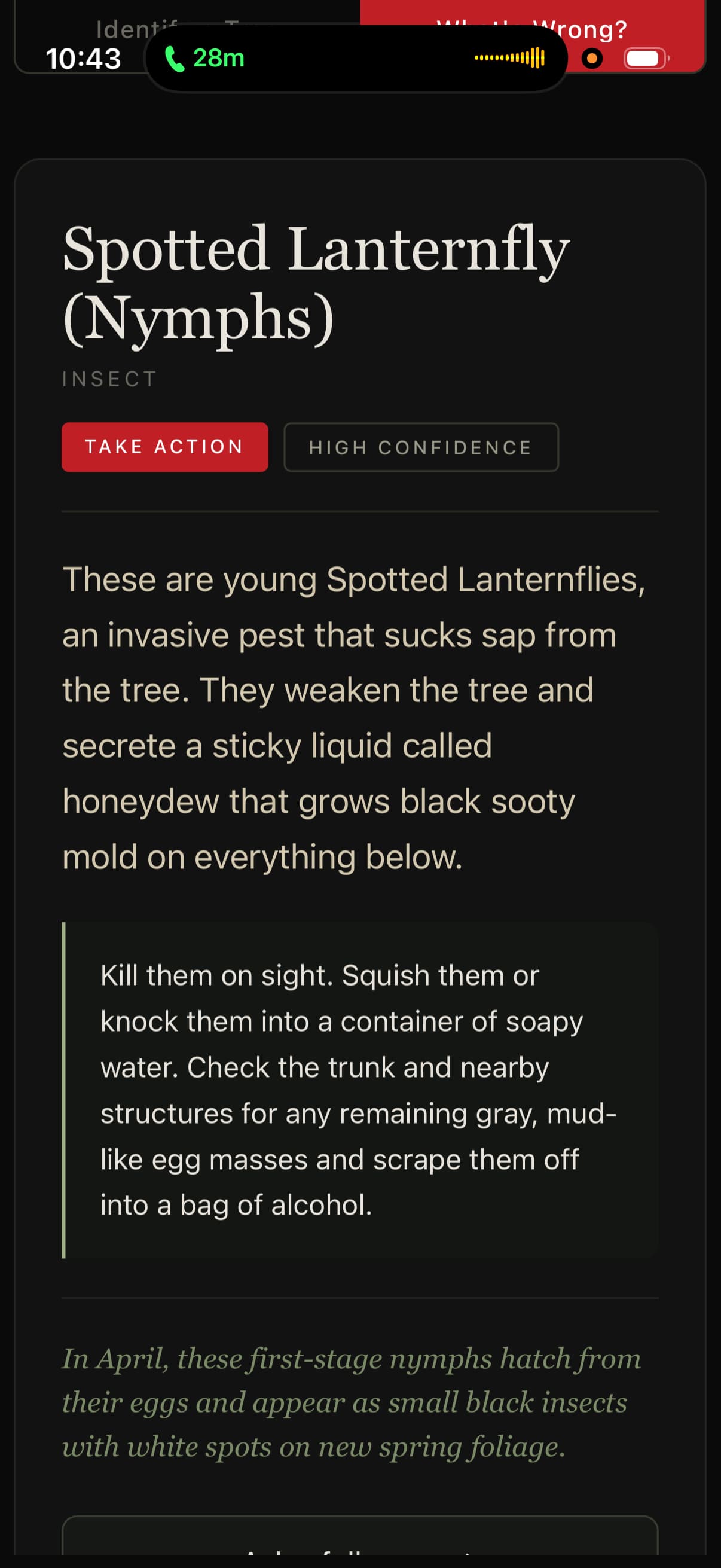
That's the bridge — homeowners answer "is this an egg sac, a nymph, or an adult" on their own, and the answer is the same one an arborist would give them. The arborists feed the chart. The homeowners feed the chart. The map is the next thing.
What you can do this week.
If you're an arborist tracking pest pressure in your head and the photos on your phone — there's a 14-day trial of ArbAssist. Property records that follow the address, soil-lab workflow, condition reports, and the data that should have been recorded ten years ago. If we're going to build a shared layer, the field notes have to start landing in something other than a notebook.
If you're a homeowner with a tree you're worried about — open CanopyKeep on your phone. Three photos for a species ID, one photo for a pest diagnosis. It's free. It will tell you what's on your tree and what to do about it this week. Then go look at your trees.
The Guardian got the homeowner action right. The vines, the canopy, and the gap between the people watching them — that's the rest of the story.
David All · Arborist in Upper Arlington, Ohio — by way of heritage apple orchards in Pennsylvania and old-growth conifers on the Olympic Peninsula. Builder of ArbAssist and CanopyKeep. Featured in The Guardian. Ohio Chapter ISA member · Arlington Tree Co.