Studying for the ISA Cert — From the Field
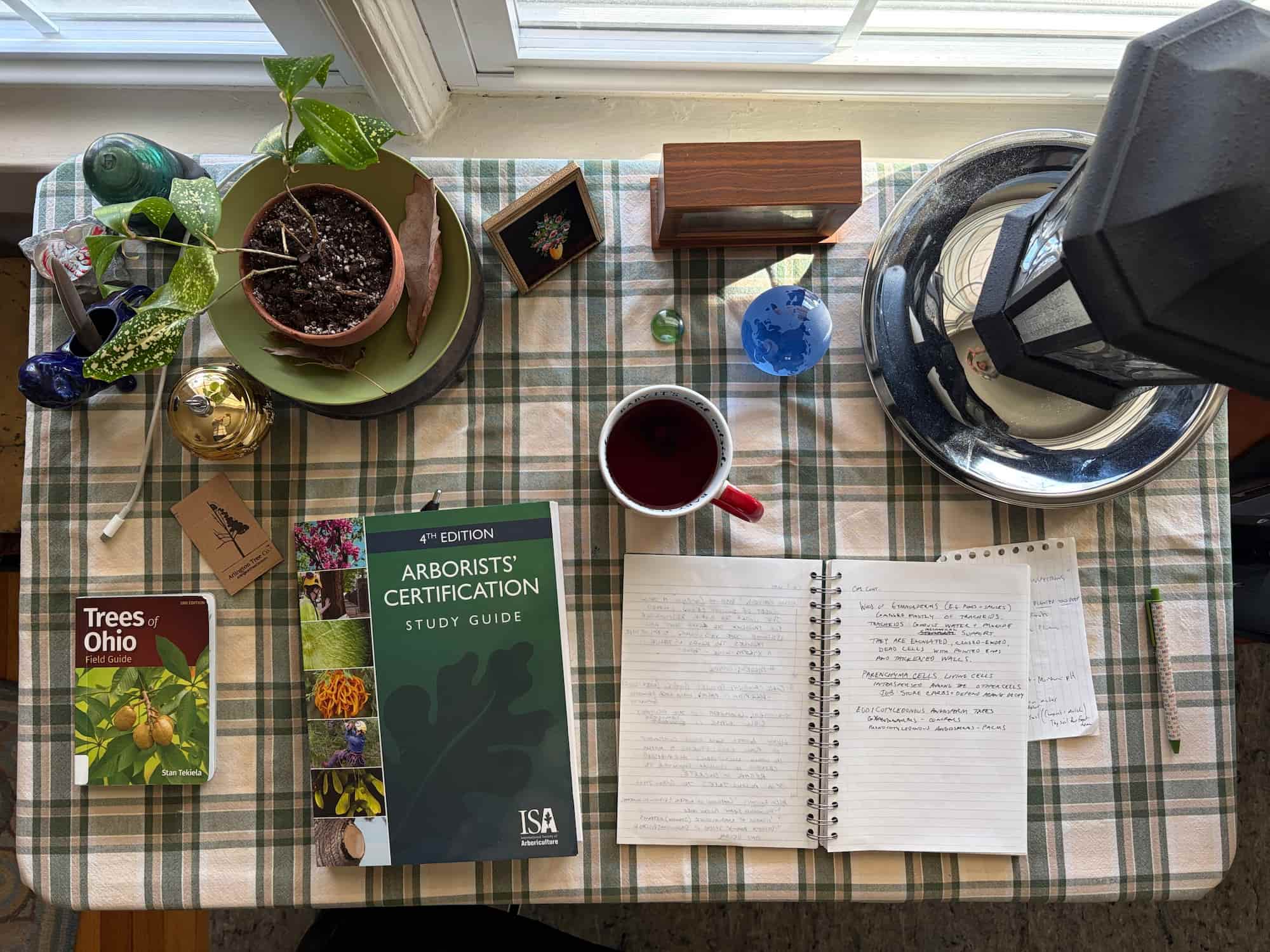
There's an ISA Study Guide on my desk this week, and a notebook beside it filling up with passages I've copied longhand. (I learn through the wrist — old speechwriter habit.) I'm working toward the ISA Certified Arborist credential, and I'm doing tree work every day, logging it in ArbAssist, the platform I'm building. The book teaches one way. The work teaches another. They're meeting in the middle.
First, an honest word about credentials.
The Certified Arborist designation is a relatively young layer on a very old craft. ISA itself draws a careful line between qualification and certification — the orchardist pruning the same row of apples for forty seasons is qualified. The land steward on the Olympic Peninsula who knows every conifer on her property by silhouette is qualified. The climber whose first day in a saddle was thirty years ago is qualified. None of them needed an acronym to know their work, and ArbAssist isn't going to ask for one before they log in.
I'm pursuing the cert because I want to be in industry conversations — about AI, soil science, what gets passed on — with a credential the certifying body recognizes alongside the work itself. That's it. Complement, not corrective.
The Ohio Chapter ISA has been the right home for that. Membership, field days, the CEU rotations that keep an arborist current — that's where the live conversation lives in this part of the country. Most of what I know that doesn't come from a book came from someone wearing a chapter name tag in a parking lot at 7:30 in the morning.
The teachers don't have it either.
Look at who's actually teaching me this craft. The caretakers. The orchardists. The master grafters. The academics. The homeowners — yes, homeowners — who've lived with the same red oak for thirty years and noticed everything. The folks showing up to Ohio Chapter ISA Field Days in work pants and field boots. The 39-year veteran with an OSU horticulture degree and no ISA letters after the name, who once walked me through Dutch elm versus bacterial leaf scorch in a parking lot on a Saturday morning.
None of them have the cert. None of their love for the work is dimmed by that.
What separates an arborist isn't the credential — it's the eye. It's the care. It's the grief, too — the small daily grief of walking past a red maple on a side street, freshly wounded by the riding-mower guy on his phone with a cigarette dangling, and feeling it in your chest. That tree didn't need a certified hand to be saved from the mower. It needed someone who would have seen it before the mower did.
That's the line the test can't ask about.
The book and the lab notebook.
The Study Guide is encyclopedic. Tree biology, soil, pruning, climbing, risk assessment, diagnosis, plant health care, urban forestry — every domain you'll be tested on, in one binding. Nothing replaces it.
But the book is the textbook. The lab notebook is what fills in the gap between reading iron lockout occurs at high pH and seeing it for yourself, in a chlorotic pin oak you visited on Tuesday.
Every visit I log in ArbAssist is, accidentally, a study session.
Every visit is a study session.
Tree records become flashcards.
Every Visit I log carries a species tag. After a year of work, I know more pin oaks, sweetgums, sugar maples, and bald cypresses by silhouette than any classroom drill could give me. The exam asks for tree ID. The phone has been quietly drilling me for months.
The Soil Lab is the chemistry chapter.
Our Soil Module runs on a Five Pillars framework — pH, macronutrients, micronutrients, base saturation, organic matter. Same vocabulary the exam uses. When I ship a sample to Penn State AASL and load the results into a tree's chart, I'm not just diagnosing. I'm rehearsing. By the time the test asks what happens to iron availability at pH 7.4, I've already answered it for a real client.
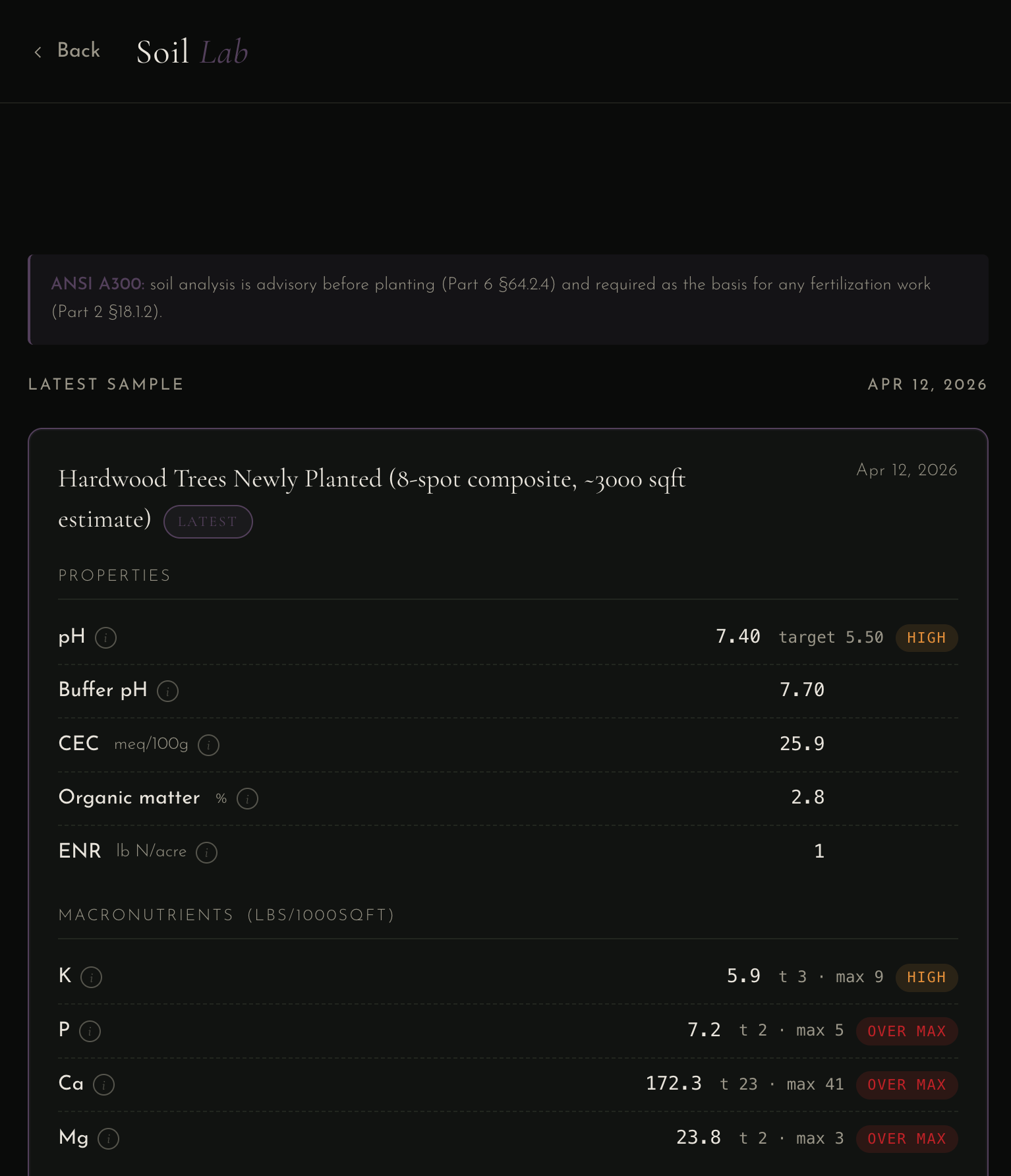
Recommendations are the ANSI A300 review.
Every recommendation I write up in a Steward Visit ties back to ANSI A300 — pruning cuts, mulch depth, irrigation guidance, soil amendment timing. Writing standards-backed recs in the field is, mechanically, the same work as writing standards-aligned answers on a test. The discipline transfers.
Field intel is the diagnosis chapter.
Pest and disease photos land in Field Intel. Aphids on the underside of an Ohio buckeye, sooty mold, scale, frost cracks, early decay — every diagnostic case I file is one I might see again on the exam, and one I'll definitely see again next season.
Visit logs are documented experience.
Before you can sit for the cert, ISA wants qualifying experience — three years full-time in arboriculture, or a degree plus one year. Every Visit in ArbAssist is timestamped, geocoded, and tied to a real tree on a real property. Not study material exactly — but the paper trail that makes the application credible when the time comes.
Hours, CEUs, and the long game.
Once you pass, ISA wants 30 CEUs every three years to keep the credential current. Field days, conferences, journal articles, approved online courses — they all count. I bank mine through the Ohio Chapter ISA's calendar. ArbAssist doesn't stamp those for me; the chapter does.
But the platform keeps the work I do between events on a chart that doesn't disappear. That's the part nobody mentions about credential maintenance: it's easier to renew when your daily work is already documented. CEUs prove what you learned in a classroom. Visit logs prove what you did in the yard.
For the arborist who isn't pursuing the cert.
Plainly: ArbAssist works the same for you. No certification gate at signup. No badge that withholds features for the uncredentialed. No cert pending state on your profile. The platform is built around the work — soil samples, visits, recommendations, photos, standards-aligned care plans. If you've been doing that work for a decade with no acronyms after your name, the app will document it the same way it documents mine.
The cert is one path. The work is the work. The trees don't check our credentials before they grow.
I'm a fan of ISA. I'm a member of the Ohio Chapter. I'm working through the Study Guide. And none of that is a prerequisite for using the tool I'm building. If you came to this craft through an apprenticeship, a family business, a forest, or an orchard — welcome. The chart is the same.
Closer.
The Study Guide goes back on the desk tonight. The visits I logged today are already in the chart. If you're studying alongside me — or if you've been doing this for thirty years and never plan to sit for the exam — I'd love to hear what's on your desk and what's in your truck.
Email me: [email protected]. I read every reply.
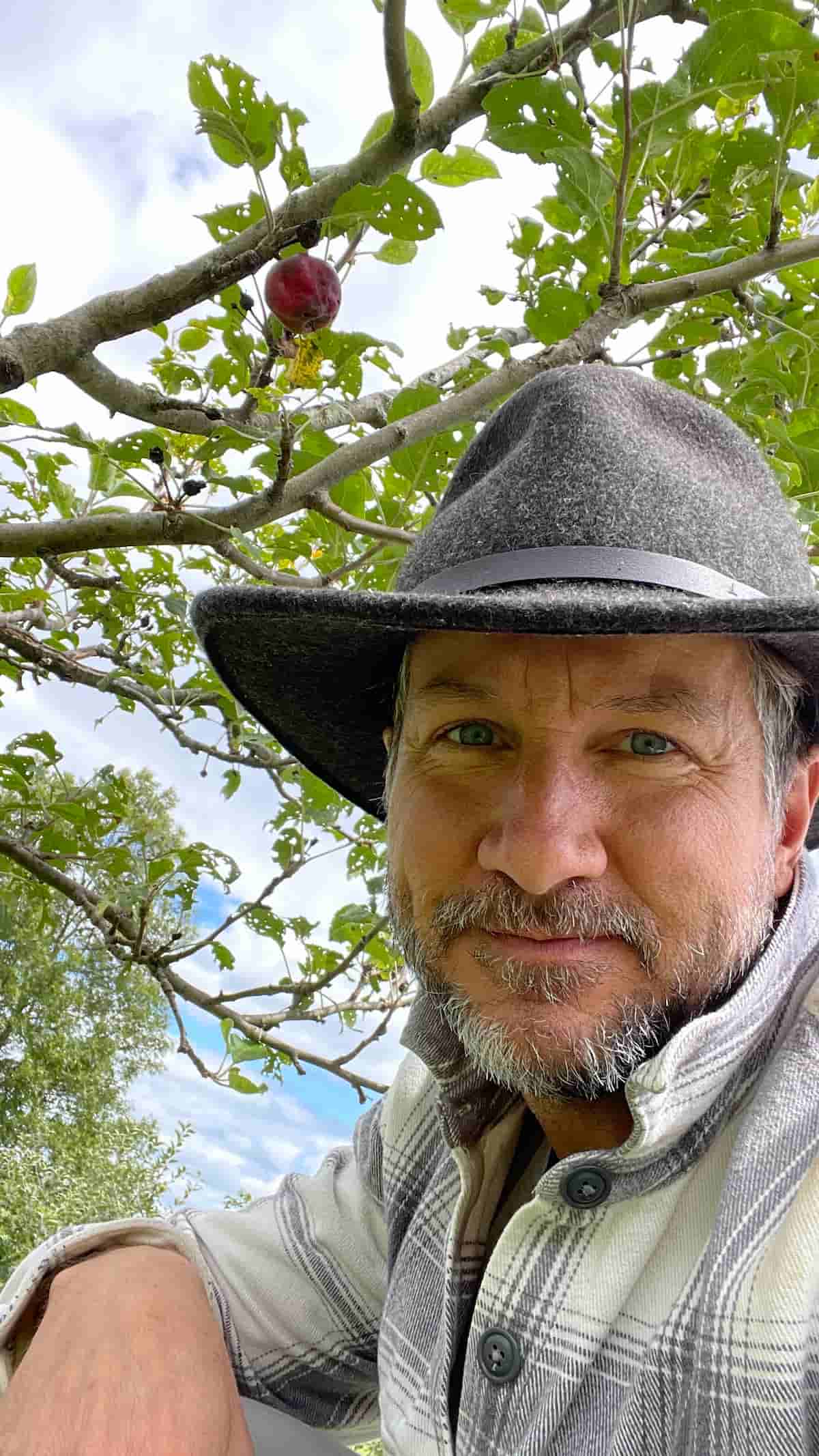
David All · Arborist in Upper Arlington, Ohio — by way of heritage apple orchards in Pennsylvania and old-growth conifers on the Olympic Peninsula. Builder of ArbAssist and CanopyKeep. Featured in The Guardian. Ohio Chapter ISA member · Arlington Tree Co.